Sciatica Sucks

Lifestyle

I find it incredible just how much we take for granted the elemental things within our lives. When I was in my early 20’s, I had a glob of wax obstruct my ear canal for a while. My sense of hearing was diminished, until I eventually got in to see an ENT; who, quite painfully, unclogged that cruddy cerumen. I remember tearing up in the last few seconds of him teasing out what looked like a nasty, slimy brown ball of goop about the size of my pinky finger tip. My point being, losing my hearing (out of one ear) for a short while made me realize how even the most rudimentary facilities we are given in life are not always fully appreciated until we are bereft of them. Thus goes everything in life I suppose. Don’t know what you got till it’s gone.

I probably spent a few days on cloud nine elated by my newly restored sense of hearing; and then sadly lost that appreciativeness and exhilaration to carrying on with the daily grind. However, today, I did not want to talk again about gratitude, but rather, yet another health problem that has recently affected me.

One pastime I enjoy most in life is receiving massages. However, a month ago after having received one – from a massage therapist I have visited several times before – I noticed a day or two later that sitting (and then standing) was tender in my right gluteal region. At first it was relatively mild, similar to muscle soreness we might experience after a solid workout. As days passed, that soreness was no longer isolated to just my gluts but started to radiate and extend down my right leg into the calf region. The severity of the pain also increased substantially, as did the frequency of when it was occurring. Tasks like sitting on the toilet and driving to work had me tearing up.

Sciatica is a nerve pain which originates in the lower back and radiates from deep in the buttocks and can travel down the lower leg. Usually sciatic nerve pain is unilateral and will only be symptomatic on one side of the body. There are several known causes, but a herniated (or “bulging”) disc in the lumbar (lower) spine is typically the most common. As a result, the nerve becomes compressed and there is pain (sharp, burning, radiating), inflammation and often times numbness/muscle weakness associated with it.

My commute to work each morning is only about 15 to 18 minutes; and I kid you not, I almost had to pull over multiple times to just stand up and stretch. Sitting for even short periods of time became excruciating. Fortunately mine was only an intermittent and postural pain; others unfortunately may experience it on a more constant basis. I had everything from a light tingling sensation, to pins-and-needles, to a strong, sharp burning and numb atrophy feeling in my calf muscle.

By the time I would arrive to work, daily, I would be popping 800 mg of Ibuprofen. That would get me through most of my day. At home, I would apply a heat pack and do some stretches. I also made one visit to a chiropractor and had some spinal manipulation and adjustment techniques performed.

“That which does not kill us, makes us stronger.” 
— Friedrich Nietzsche

According to SPINE-health.com, this affects 10-40% of the population, typically around the age of 40 years. Also, certain types of occupations (perhaps dentistry?) who often bend their spine forward or sideways or raise their arms frequently (okay, definitely dentistry!) may be higher risk. Thankfully, most cases typically get better with nonsurgical treatments within about 4 to 6 weeks. Some have persistent (over 1 year), and even progressive symptoms, in which case sometimes surgical intervention may be indicated.

As I write this, I am relieved to say my sciatic nerve pain is the best it has felt in over a month. It exists still, but not at an unbearable level like a month ago. Time, medication, proper stretches, heat therapy and the hands of a good chiropractor seem to have helped me make nearly a full recovery. Who knew something so simple like a drive to work or sitting on the toilet could be so painfully agonizing. Sciatica sucks!

Okay, so I have some PTSD about getting massages now. That is a blog post in and of itself. If you are just starting to have sciatic nerve pain, I am happy to share with you some of the Youtube videos and bookmarked websites I have on stretches that were effective with managing my pain. Please feel free to contact me directly or leave comments below! Thank you for taking the time to read this post, I appreciate it!

Craving the Controller

Lifestyle, Uncategorized

Throughout my life I have witnessed the evolution of video game systems. In 1985, I was six when Nintendo released their very first game console (in the United States). My parents gifted it to us a couple years later, but once it arrived into our house, my brother and I were hooked. We would play Super Mario Brothers, Duck Hunt, Zelda, Contra, Tetris, etc. so much that the unit would overheat; and of course we would simply take the game cartridge out of the console, and with great fervor, would blow on it until we were blue in the face. Then we would immediately pop it back in to the console and hope that our near cyanotic episode was enough to buy us a couple more hours of play. We knew cheat codes (“up, up, down, down, left, right, left, right, B, A and Start”), glitches in certain games, hidden levels, you name it.

Over the years, we weren’t ‘lucky’ enough to own every platform that was introduced onto the market. In fact, we owned the original NES (Nintendo Entertainment System), the Super NES, and a first generation XBOX. That’s it. Never an Atari, never a Sega Genesis, nor any of the Sony PlayStation series. I know what you’re thinking – what a rough and deprived childhood I must have had, right? Tell me about it.

In elementary school, I can still recall sleep-overs at friends houses staying up all night rescuing the princess from Bowser in Super Mario Bros. or button-smashing away to defeat (Mike Tyson’s) Punch-Out(!!). I would invite junior-high friends over right after school to come play Street Fighter II or Teenage Mutant Ninja Turtles on the Super Ninetendo system. But I actually hit a peak of ‘addiction’ later in life, right before registering for dental school, when three friends and I would get together every week or so and play the game Halo. No joke, we would play basically from early evening until the sun started to crack through the shutters. Then I would somehow make it home, and dream about Valhalla (a map in Halo), and snipers (a weapon in Halo), and trying to annihilate my friends at the game. We loved the online multi-player option for Halo, but we’d still meet regularly for the camaraderie and joy of witnessing someone’s face when you just finish rocket launching them from behind.

Life ended up interfering with our Halo group. I eventually started dental school, one friend moved away to Phoenix, another left to serve in the military and it all just unfortunately fizzled out.

A few years ago, I got excited to gift my two boys a Nintendo Switch. My wife initially opposed the idea. She was nervous (and rightfully so) that our boys would become addicted to video games. According to this article, 6 to 15 percent of all gamers exhibit signs that might be characterized as addiction. Emotional signs such as a feeling of restlessness or irritability when unable to play, preoccupation with thoughts of previous online activity or anticipation of the next online session, lying to friends/family about the amount of time spent playing and also staying isolated from others in order to spend more time gaming. Some physical symptoms might present as fatigue, migraines from eye strain or intense concentration, Carpal tunnel syndrome, and exhibiting poor personal hygiene.

Video games today are undoubtedly better than the 8-bit, pixelated consoles I used to play on. The graphics are insanely good, the online multiplayer setup gives them a social setting to feel accepted in, and all-round the games are designed to be more addictive then ever before. What’s worse, many games now are streamed – requiring minimal computing power and little more than a solid internet connection. Gaming companies have also become increasingly cunning in that they offer games for free and instead, now charge for things within the game. If not offered free of charge, have moved towards a monthly subscription-based model versus when I was a kid and my parents would have a one-time charge to buy the cartridge. Also, games now-a-days rarely have “levels” to beat, and therefore allow for continuous play and generally have no ending.

After dental school/residency, I never resumed my love of video games. I have so many precious memories, but now – older, more educated, more enlightened, more self-aware – I can’t help but consider the opportunity costs on the countless hours I spent on video games. I should have participated in sports or clubs instead of rushing home to turn on the Nintendo. How much better could I have done with my education? How much earlier could I have entered my career?

“Changing our thoughts, actions, experiences- and in the process changing our brains- is what will help us finally feel satisfied and free from the desperation of not being able to get enough.”

– Omar Manejwala

We ultimately decided to purchase the Nintendo Switch; however, that ended up not being the source of their addiction. After all, there are computers, phones, tablets, Apple TV’s, and so many other means of accessing games if they so desire. Before it was Angry Birds and Candy Crush. This generation seems to be all about Minecraft, Roblox, Fortnite, and something new seems to come out every day.

There have been studies that show an alarming correlation between video game addiction and depression, restlessness/sleeplessness, and even substance abuse. It can grow to be quite dangerous.

For a short while, I contemplated setting up parental controls, installing spy software, and cutting offer internet access to get them to stop playing so much. However, I genuinely do not believe that will inhibit addictive behavior. It is more reactive versus being proactive; and I feel like they will always find a way around the barriers I keep putting up. I would rather find solutions and methods that help decrease their cravings as well as distract them from thinking about gaming in the first place.

What I have found so far to be the most effective thing at helping overcome their dependency on video games and screen time as a whole is enrolling them in outside activities. Our kids take tennis classes, Kumon tutoring, and piano lessons. On weekends, we will try and do family board or card games, bake together, or go to the park. As dental school seemed to do for me, my hope is that – if we offer them better ways to occupy their time, and minimize exposure to the addictive substances – hopefully the brain rewires and overcomes dependency on things.

Everything in moderation, right? I think depriving them outright is not fair; they should be able to have some commonality and shared interests with other kids their age. But I want them to not be constantly thinking about them, or throwing tantrums when we tell them to turn it off. I want them to read books, spend time outdoors, interact with people, observe the world around them, become cultured. Recognizing and controlling obsessions and addictions is not easy for anyone; however, with some help and support from family and friends we hope to overcome these obstacles in life.

I love self-improvement, mental health and various psychology topics; I would be curious to know if anyone else has similar experiences and other good options to overcome addictive behaviors and tendencies. Please feel free to leave comments or contact me with your thoughts. Thanks for taking the time to read this post!

Hiding My Hair Loss

Lifestyle, Uncategorized

This next post has been a long time coming. On this site, I have written about my astounding student loan debt, my parenting faux pas, my time as president of an organization, and even a disconcerting medical condition that occurred to me fairly recently. Perhaps the reason I have been so reluctant to write this next post is because I have spent so much time, effort and money over the years trying to conceal this problem in the first place. Well, without further ado, here is a little tale about my struggles with hair loss.

In my early 20’s, I started noticing a few hairs on my head started to go scraggly. Even more distressing were the ones that would shed outright; usually discovered to my dismay while shampooing in the shower. Certain, close family members of mine (i.e. uncles) had an early history of hair loss; but my father retained a healthy mane well into fifties and sixties, and my mother (while thin) didn’t have any appreciable alopecic areas on her head. Please note, there can be genetic (e.g. family history, male sex hormones) and/or environmental (e.g. stress, nutritional deficiencies, thyroid conditions, etc.) causes to hair loss – I would strongly encourage everyone to seek the true etiology before starting on any particular treatments and therapies.

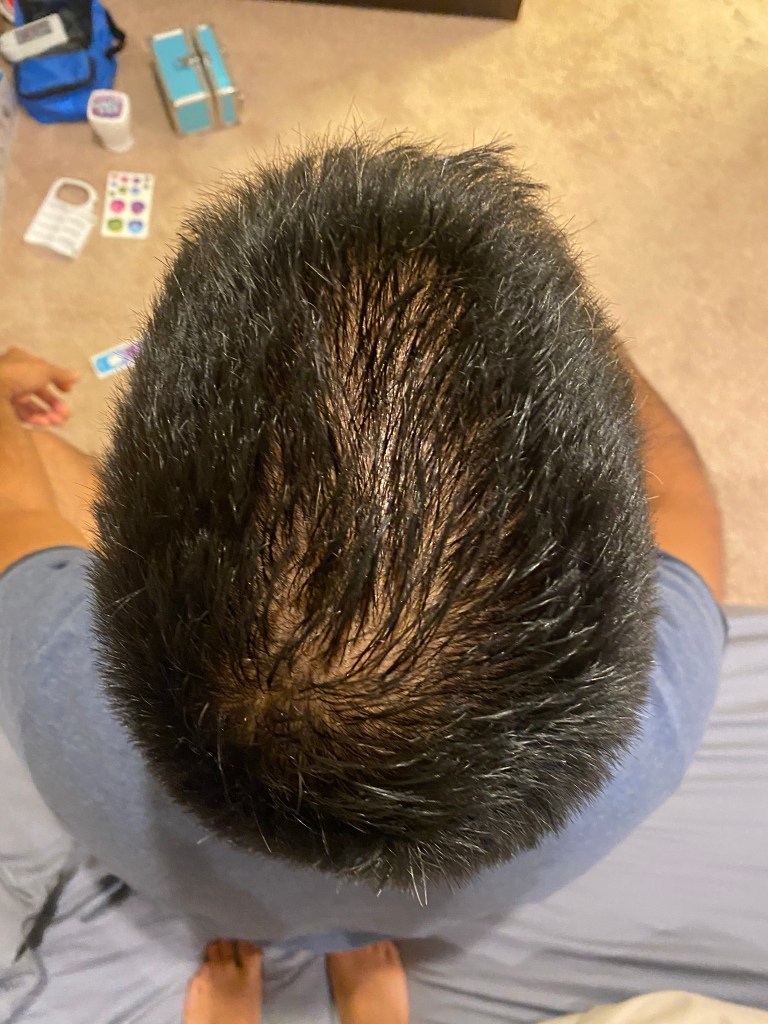
I just knew mine was not your normal ‘ordinary day’ hair loss. I started noticing discernable areas of my scalp in the mirror. By 23 years old, I took it upon myself to start visiting dermatologists and hair-transplant consultants to see what my options are. My form of hair loss, as best as I can tell, is the typical male pattern baldness known as androgenic alopecia. Back then (and perhaps even now?), the Norwood Scale was used to gauge the various patterns and stages of balding.

The Norwood Scale

Fortunately for much of my twenties and thirties, I fell under a Norwood stage I classification – where, especially when styled just right, there was not much noticeable change in the hairline or elsewhere. Now, in my forties, I have progressed to a stage III/IV where the hairs on my vertex/crown have more appreciably thinned and there is more generalized loss within my front and mid-scalp sections.

The dermatologist I saw in my twenties (and who has since retired) was a family friend of ours. With great reluctance, he prescribed me Propecia to help slow my hair loss. I say “reluctance” because, however rare, it may have sexual and other adverse side effects. He also made me promise that, when my wife and I decide to start a family, I stop taking the medication for several weeks (preferably months) prior to trying to conceive in case it may cause some unintended birth defects in our unborn child. Again, please consult a health care professional before starting any particular treatment; but personally I credit this medicine for retaining much of what I have left on my head today.

As I’m sure we all do in times of weakness and vulnerability, I turned to the Internet for answers. Forums like Hairlosstalk.com became my obsession, and I was constantly seeking other cocktails, potions, elixirs, “cures”, what have you to supplement and help stop (or better yet, reverse) my hair loss. Let me assure you, men’s hair loss is a multi-billion dollar (and growing) industry and there is no shortage of ‘strand-restoring’ products out there. Perhaps it was the recommendation of strangers online, or simply succumbing to the brilliant advertising and the promises of “stimulating regrowth” and “reactivating hair follicles” on the Rogaine packaging; but soon after starting Propecia – I found myself also applying 5% Minoxidil topically 2x a day.

Propecia and Minoxidil was my hair loss treatment regimen for over a decade, with relatively decent results. The scraggly hairs were no longer an issue, and hairs would still fall out in the shower, but in what seemed like more stable, ordinary amounts. I purchased expensive shampoo’s (e.g. Revita Hair Growth Stimulating Shampoo), tried vitamins (e.g. Viviscal Pro), used a micro-needling roller a few times a week, and even bought a laser helmet (e.g. Theradome EVO Laser Hair Growth Device) – but nothing really helped to any significantly appreciable degree.

About a year or so ago, I started noticing my hair receding in more substantive amounts again. I don’t know if there was elevated stress from the whole Covid-19 time period, I don’t know if maybe the tolerance or the efficacy for the medications I have been taking has started to reach its limit, it’s impossible to say. Nonetheless, it has concerned me enough that I have again started up consultations with dermatologists and hair-transplant specialists.

So far, the consensus among the three or four doctors (some dermatologists, some surgeons) I have met with (in-person or virtually) is that I am still not an ideal candidate for a hair-transplant (either FUT or FUE) procedure. While, in some strange way, that feels reassuring to hear – I am constantly paranoid about this problem progressing. My most recent research into hair loss remedies has introduced me to PRP (Platlet-Rich Plasma) Injections – which seems to be gaining popularity for this and other health conditions. Pricing and the recommendation on frequency seems to vary among providers, but I am resolved that this will be the next logical therapy in my desperate attempt to slow/stop my hair from falling out.

I would be remiss if I did not mention the psychological ramifications in all of this. While I recognize (and appreciate) that I am a lot better off than some male men in their forties, I can’t help but feel down, depressed, and distraught about my decrepit appearance. I already know my facial type is not fortunate enough to look good with a bald head, like the Bruce Willis or Dwayne Johnson’s of the world. I hate being so vain, and already struggle emphatically with aging and my fleeting youth. I spend SO much time trying to hide and disguise the problem; time I could spend with my kids, reading, exercising, just all-around bettering myself. So much expended energy worrying about how many strands I have waiting on the shower floor or in my comb. While I didn’t experience any erectile disfunction (thankfully), it is hard to pinpoint the hormonal changes that happen when you’re on medications (especially, electively) and the negative effects it may have on testosterone production and energy levels. I wish I could come to terms with it, accept and embrace it, age gracefully and focus on what really matters in life. For me (and many others suffering a similar fate), having hair is very much integrated into our identity, our self-esteem and our self-confidence; it a symbol of our youth, virility and feeling of attractiveness – and not so easy to let go of.

So, on that propounder-ing note, I thank you for reading this latest post. As with so many other topics, I wish I had better photographic documentation to incorporate in this post. Please feel free to contact me or leave any comments to discuss your own personal story and struggles.

Investing and Gambling(?)

Lifestyle, Uncategorized

Being born and raised in Las Vegas, growing up around slot machines and poker/blackjack tables, perhaps helped desensitize me a bit to the appeal of gambling. In my early twenties, I worked as a web developer and programmer for a local gaming company and it helped solidify in my head the notion that ‘the house always wins.’ As much as I love the idea of getting rich quickly, I knew that – at least in casinos, the cards were stacked against me.

After we paid off our student loans, I started to take some of that monthly income and began investing. Fortunately, I had already been reading content from The White Coat Investor for years; and his philosophy on refinancing, saving, investing – it was ingrained deeply within me. Now, there is A LOT to investing – certainly too much to cover for a mere post where the author tends to write extemporaneously i.e. here. There are countless books, websites, blogs, podcasts and forums in which to educate yourself and start the journey.

As always, I am happy to share with you the little information I have gleaned over the years. For starters, I subscribe to a FIRE (financial independence, retire early) movement; in which adopting a certain disciplined lifestyle and setting financial goals helps someone achieve freedom from the workforce. Of course raising your annual income, lowering your expenses, increase your saving/investing rate, maximize retirement accounts, reducing your tax liabilities, living below your means, etc. – it all feeds into successfully reaching this goal. Also, familiarize yourself with the 4% rule. In order to sustain a 30-year time horizon in retirement (adjusted for inflation), your nest egg should have about 25x what you expect to spend annually stored away.

Which brings me to my next point – calculate your savings rate and track your monthly/annual expenses. In addition to using our Mint account to budget and track expenditures, I also use an Excel spreadsheet to simply monitor our overall finances (monthly income, account balances, investment gains/losses, etc.). Consciously (and maybe, subconsciously?) seeing these numbers regularly not only keeps us organized and informed, but (for me at least) motivates me to improve/correct some spending habits. Generally my family stays within a 30-50% savings rate every month. Depends how early you start, but I have read a 20-25% rate (at least) is typically what you want to shoot for.

In order to start investing, I created an account (brokerage and retirement) with Vanguard. I love the story of Jack Bogle, the founder of The Vanguard Group – which was really my only deciding factor to open my accounts with them. I imagine Fidelity, TD Ameritrade, Charles Schwab, etc. have just as good (if not better) platforms set up as well. All my ‘long-term’ investing is done in Vanguard. There is some ‘uncompensated risk’ that goes along with investing in individual stocks and specific companies. Theoretically, a company can go bankrupt and you stand to lose everything. My distribution or asset allocation in my Vanguard account looks something like this: 1/3 Vanguard Total Stock Market Fund, 1/3 Vanguard Total International Stock Market Fund and 1/3 Vanguard Total Bond Market Fund. Every month, whatever I can contribute, gets split evenly amongst these three. The growth has been steady enough over the years, and there is a certain serenity in knowing my risk is drastically minimized because index funds are highly diversified. Another reason I have come to love Vanguard is because their fees and expenses to purchase and own these funds are so low compared to some other companies.

About a couple of years ago, I opened up a Robinhood account as well. All my ‘short-term’, active trading takes place there. Every month, a very small percentage of the money I set aside for investing purposes gets deposited here. Honestly, I consider this ‘play’ money – it affords me an opportunity to invest in companies I like (i.e. Apple [ticker: AAPL], Tesla [TSLA], Costco [COST], Netflix [NFLX], Berkshire Hathaway [BRK.A – which I can’t afford, and BRK.B]), and dabble in speculative stocks like GameStop (GME) if I so desire.

It has been interesting to see how my Vanguard (i.e. long-term, passive trading) compares against my Robinhood (i.e. short-term, more actively traded) account performs. The Robinhood app makes it super easy to execute trades; and within that simplicity, I think a lot of people succumb to their emotions and either 1) sell in a panic when the market or stock price is down or 2) buy in big on hyped-up meme stocks that are supposedly ‘going to the moon.’ Investing 101 teaches you either of these can be dangerous and really cut into your long-term gains. Timing the market is impossible. In my own experience, giving myself a fixed allowance every month to ‘dabble’ with has worked well; it allows me to keep myself in check and not get too carried away. If I happen to randomly pick some winners, great! However, in my mind, every single dollar I have placed into that Robinhood account is mentally money I have come to terms with completely losing. And just FYI, my Vanguard account is currently well out-performing my Robinhood gains.

The same appeal, and that ‘rush’ people get in casinos by putting it all on red (a reference to the game roulette in case it was missed) – that is a similar adrenaline high I get when putting a purchase order in on the Robinhood app. It can certainly be addictive, and really get you into some trouble. Which is partially the reason that I have not ventured into cryptocurrency trading, I do not feel I understand that investment vehicle well enough yet.

Arguably one of the most famous investors of all time, Warren Buffett, said quite a few things pertinent to my topic today. He said:

On Earning: “Never depend on single income. Make investment to create a second source.”

On Spending: “If you buy things you do not need, soon you will have to sell things you need.”

On Savings: “Do not save what is left after spending, but spend what is left after saving.”

On Taking Risk: “Never test the depth of river with both the feet.”

On Investing: “In the business world, the rearview mirror is always clearer than the windshield.”

Of course we all want to maximize our returns while minimizing our risks. However, there will be investment fees and expenses, market corrections/depressions, and asset classes that underperform just to name a few. Most investments just need TIME. The concept of compounding interest works; and for those individuals passionate enough to educate yourself, responsible enough to control your lifestyle, relentless and patient enough to withstand (and minimize) the failures along the way – I think they will earn the right to FIRE.

Thanks for taking the time to read this post! As a full disclaimer, I do not possess a business degree, have no formal financial training, do not stand to benefit any monetary gain from the companies mentioned above, and – for some – would recommend you seek assistance from a financial consultant or trained professional before beginning this endeavor. As always, feel free to ask any questions or leave any comments for me!

Figuring out Fatherhood

Dentistry, Lifestyle, Uncategorized

Colleagues in the dental field, upon discovering I do pediatrics, always squeeze in the phrase “it takes a special kind of person” somewhere into the conversation. I have also heard the words “thank God for people like you” on more than one occasion. If you have read any of my previous posts, I almost never miss an opportunity to gloat about how lucky I am to do what I do. Sure, there are stressful moments mixed into each work day – the deafening loud screamers, the biters, the pukers, and my personal favorite, the parents that tell me how to do my job. However, I would not trade my profession for any other, ever, period.

I imagine that the “special kind of person” comment implies there is a certain degree of patience and compassion for these little patients that those individuals maybe do not have a want or willingness to exert. Mind you, I do not say that judgmentally. I recognize that everyone on Earth has different skills, talents, and abilities – and what suits me may not befit someone else. I already established in my last post that I certainly do not have what it takes to be a Chippendales dancer.

Nevertheless, this notion that I may somehow possess a special amount of patience is an interesting one. At work, I am proud to say, I always try and maintain the utmost professionalism. I treat children with low-functioning autism, with attention deficit hyperactivity disorder (ADHD), and with various other medical and behavioral conditions. The truth is, throughout most of my brief appointment – whenever I have an unruly child in the chair – I think to myself how demanding and taxing it must be for the parent to take this on day in and day out. Really, kudos to them.

At home however, unfortunately, my parenting style does not always feature that same calmness and composure.

When I was younger, well before my children were born, I was driving down the street, stopped at a traffic light, with my window rolled down. At the same street corner, waiting to cross, was a father and his young boy (probably no more than around 7 or 8 years old). I caught only a brief portion of their altercation before I had to resume driving, but the dad was berating his son about his bike, either ruining it…not riding it properly, something to that effect. I remember thinking to myself, how could any material object be worth laying into your kid like that?

Little did I know back then that I would have progeny of my own one day. As recently as yesterday, I chastised my younger son for 20 minutes about being too distracted/not concentrating and doing ‘poor quality work’ on his Kumon (a math and reading tutoring program) assignments. (Ironically, he’s eight.) It is a lecture I have given to him time and time again. A few months ago, at a park, he left his tennis racket unattended somewhere and it was stolen. The drive home was filled with my reprimanding him about being more responsible with his things. I guess, so much for my ‘material objects’ memory huh?

I wish every moment could be remembered like this one above.

For the record, I am not proud of these outbursts and punitive moments of mine. All too often, I ultimately regret the vehement way in which I handled the situation. My biggest fear is the emotional scar and substantiality of the memory it creates in their mind. Although for me, disciplinary moments like these seem infrequent and tend to occur far and few between; in the mind of a child, I imagine it carries immense weight and detracts from the many jocund times we share together. And that is sad to me; because I truly do make concerted efforts to play with them, talk with them, take them places, and provide them things that I was bereft of as a kid.

The reasons for (and root cause of) my overly aggressive outbursts are probably outside of the scope of this blog post. But like so many other things in my life, in an effort to right wrongs, I try and self-reflect on shortcomings and character flaws within myself. I need to work harder at managing my expectations for my kids. While (I think that) I am trying to instill a good work ethic in both of my boys; I feel I am also setting myself up for disappointment and frustration when they aren’t delivering on things I myself believe to be important. I have to learn to exercise more patience and tolerance to the simple fact that they are children; and mistakes, and messes, and imperfections in all forms will help them learn, cope, and even correct certain behavior in the future.

When I think about the miracle of childbirth; and how even from the point of conception, we need so so so many countless processes to go right before we’re given a beautiful, healthy baby – I almost feel ashamed of myself that I let petty things like messy handwriting or a stolen tennis racket ruin a moment and a memory in time I have with my two young boys. Don’t get me wrong, disciplining and punishments have their place. I am just going to make more of a conscious effort to handle their foibles and failures with a tad bit more of tranquility. Every child is a blessing; I have to work harder to appreciate that fact not only at work but within my own home.

Really, thanks for taking the time to visit this blog and read through some of these posts. I can always use help in the parenting space, so please feel free to send any comments and questions my way!

My Exercise Expedition (Part I)

Lifestyle, Uncategorized

I suppose before I get into this next post, I should probably apologize in advance to all the parents and/or patients that I provide dental care for; this post will likely feature way more about your dentist than you ever wanted to know or see. Now that the disclaimer is out of the way…I wanted to dedicate this post to one of my (few) hobbies and pastimes, physical fitness.

I started working out probably in my late teens, early twenties. In fact, in my early twenties – a time when my body actually knew how to properly metabolize food – I remember getting a free body fat percentage check and it was pretty much in the range of where male athletes typically fall (i.e. 6-13%). Of course, I had youth on my side, no family at the time (i.e. less responsibilities, arguably less stress), a strict vegetarian diet, and I recall going at least three to four times a week (immediately after work) to the gym. I looked and felt great.

Unfortunately, you will have to take my word for it. You see, back then, smart phones had not yet been invented and I am pretty sure the term ‘selfie’ wasn’t even coined yet. Even if it was, it would have been such a pain to take regular 35mm film photos of my shirtless self, hope to God they weren’t blurry, drop them off to be processed, pick up the prints in the typical 7 to 10 day window, put them into my super slow flatbed color scanner, and all that – for what? To place them onto social media websites and dating apps that hadn’t even been invented yet? No thanks.

We obviously live in an age of information overload. We have so many fitness diets and workout programs, P90X’s and Pelotons, and a slew of Youtube training videos all guaranteeing 10-minute abs. CrossFit is all the craze, tons of Zumba zealots, and people are quite passionate for Pilates and of course Yoga routines. I wish I could tell you that I have tried a number of these programs; and offer you a list of the ones that have been most effective for me. The truth is, my family and work schedule are not conducive to my attending many of these classes, and frankly I am too cheap to subscribe to anything I cannot fully commit to.

In that same vein, let me take a moment to caution my readers that I am by no means a fitness expert. I have never recruited the help of a personal trainer, have no professional education in physical fitness, have never met or spoken with a nutritionist and/or dietitian, and essentially possess a basic understanding of the anatomy and physiology of our body.

2018 – Not a Chippendales dancer

Temporarily ignoring the messy counter-top, the filthy residue on the bathroom mirror, and the stack of laundry on the tub behind me…that was my body in late 2018. Back then, of course, there was no such thing as COVID-19 and therefore, I was not hyper-paranoid about avoiding the gym. Honestly, I never controlled my diet; but I exercised routinely, drank WHEY protein shakes on occasion, and would try my hardest to power through a good workout session.

2021 – Still not a Chippendales dancer

Fast-forward to 2021. Interestingly enough, three years later, and the nasty mirror residue and messy counter tops are still there! The big difference being, I am now quite noticeably way more gray up top. Anyways, since COVID is still very much a threat, I have invested in a small home weight rack (from Costco), and I work out to Youtubers like Heather Robertson and Midas. Also, lately, I have been making a conscious effort to cut back on processed foods and minimize my sugar intake. Finally, I try to be careful to drink plenty of water and get solid sleep every night.

My workout goals right now are to get more definition in my core region, rid myself of that stubborn belly fat (i.e. lose the love handles), and build muscle (without bulking up too much).

I am only a few weeks into a regular workout regimen. Three or four times a week, I wake up early and try and work either back/biceps, chest/triceps, shoulders, legs, and/or core and abdominal muscles. Already though I feel a boost in my self-confidence and mood, I feel more energetic throughout my day, and I feel overall just healthier. Ugh, I love that rush of endorphins at the end of a good workout!

The pain you feel today is the strength you feel tomorrow.

– Unknown

For anyone starting to exercise and get fit (again, I am no expert); I would encourage you to set achievable goals for yourself, simultaneously control your diet and calorie intake, and be sure to watch your form so you avoid injuries. For me personally, the hardest part is just starting a routine after a long hiatus of not exercising; overcoming that initial laziness, doubt, and mental fatigue. It definitely requires self-determination, hard work, discipline and sacrifice.

Thank you for taking the time to read this post. I am not afraid to admit there is still so much I need to learn, and welcome any advice you are willing to share. If you have any specific questions about my own routine, I am always happy to share. I will continue to keep you all posted about my progress on this journey, and hopefully I will get around to cleaning that bathroom counter and mirror!

Enabling vs supporting

Dentistry, Lifestyle

Today, I attempted to do some fillings on a highly anxious nine-year-old girl. She was sobbing practically non-stop, grasped tightly to her stuffed animal, and basically blocked/ignored all of my various behavior management techniques. Mentally she did not succumb to the oral sedative, she could not care less for my tell-show-do spiel, and she could not bring herself to stop crying well enough to tell me what was frightening her. The mother denied any past emotionally-distressing dental visits and claimed she behaved perfectly fine with her other medical doctors. Needless to say, I accomplished nothing in the office and her parents were made aware she will likely need to go under general anesthesia to get her dental treatment done.

Very few of my appointments are completely aborted like this one was. In fact, the rarity of it is probably why I am so heavily bothered right now; and I only wish I could have more effectively understood this patient’s disposition. In a child with a learning disability or mental health issue, (at least to my aberrant mind) there is more of a justification to why that individual may not be able to tolerate such a procedure. However, a supposedly healthy, ‘normal’ nine-year-old (with a stuffed animal?) without any previously traumatic dental appointments acting with such resistance really makes me question her resilience and coping skills for other difficult situations in her life.

There are some psychology concepts we briefly discuss in pediatrics such as (B.F. Skinner’s) operant conditioning, and positive/negative reinforcement and how each influences desired behavior. I also try to stay mindful of the developmental milestones children should be achieving, and try to raise awareness and arrange appropriate consultations when they are clearly not being met. The patient I had today clearly exhibited extremely fearful behavior (i.e. crying uncontrollably), still relied on comfort objects (i.e. stuffed animals), and willfully refused to be verbally interactive. Let’s assume she is not developmentally delayed; when someone exhibits such uncooperative misconduct, and realizes it provided her the outcome she desired (i.e. not getting dental work done) – my concern is, could that moment reaffirm in her mind that poor behavior rescues her from all circumstances she deems uncomfortable? What is the lesson she took away from today’s visit?

It begs the question though, where does parenting style play a part in all of this? In the few moments I was in the room with her, this parent met the criteria of a stereotypical “helicopter mom”; in that she hovered closely over the child the entire time (never once out of reach) and a bit overly involved in trying to pacify her daughter throughout the process.

Now, by no means do I profess to be the perfect parent. Far from it in fact. As you may know, I have two young boys. One has a borderline addiction to Minecraft and the other has a very unhealthy affinity for watching scary YouTube videos featuring Slender man. One tends to be clueless about his surroundings, messy and irresponsible with his belongings; while the other can have uncontrollable temper tantrums, often times is quite passive-aggressive, and (no joke) may one day turn out to be a kleptomaniac. At eleven and eight years of age – they already seem to know the full catalog of curse words, they consistently stay up past their bed time by at least an hour, and disobediently raid our pantry in search of sugary snacks.

In retrospect, I am starting to realize just how often I inadvertently enabled my children’s undesired behaviors over the years; all under the guise of trying to be ‘supportive’. Like when my son forgot to turn in multiple assignments throughout the school year, and my wife and I pleaded with their teachers to accept their work late. Even with minute challenges, like tying their shoe laces for them or cutting up their meals into bite-size pieces – these were obstacles they could have easily overcome and a great opportunity to build up their confidence.

It is perfectly natural to want to protect our children from difficult situations, or experiencing failure, or enduring pain, or undergoing embarrassment. Before we know it though, they’re older – and if we have shielded them from all of their struggles, I feel we may have deprived them of developing essential coping skills and the ability to build up resilience.

“We don’t grow when things are easy, we grow when we face challenges.” ─ Unknown Author

Within my own life, I know conflict has always helped me be more confident and grow as an individual. There is a sense of empowerment when we face fears and overcome obstacles. Lately, I not only ask my children to exercise perseverance and more independence through the problems they face within their own lives; but also, allow them to suffer more consequences and tackle some relatively uncomfortable situations without parental intervention.

I wish every child I treat in my clinic could have a pleasant and pain-free dental experience. Many kids unfortunately are overwhelmed with fear and anxiety before they even step foot into our office. “We are a sum total of all our experiences.” (BJ Neblett). I do not presume to be able to correct the behavior of every child within my one-hour appointment. Their past dental experiences, their environmental influences, their parent’s parenting style, and much more are all considerable factors. Fortunately we have various treatment modalities, and perhaps with time and enough positive experiences, even the nine-year-old with the stuffed animal can one day feel comfortable getting work done in the dental chair.

Thank you so much for taking the time to read this post. Please feel free to express your own thoughts and feelings on this matter, I love to hear various point’s of view.

Vacations vs burnout

Dentistry, Lifestyle

Contractually, I get ZERO paid vacation days a year. That is not to say I cannot take time off. In fact, my employer is quite accommodating of my vacation requests. However, when I am not in the office and not seeing patients, I am forfeiting any and all income for that period of time. Needless to say, that causes some internal conflict.

When I was younger, I remember someone telling me about the concept of ‘opportunity costs.’ They pointed out an example of how because Bill Gates’ net worth is worth so many several billions of dollars; that it literally would not be worth his time to pick up a $100 bill if he were to drop it on the ground. In fact, he called it a ‘poor investment’ of his time.

In the early part of my dental career, that same decision-making process always stirred in the back of my mind. Essentially, when I go on vacations, not only do I not bring in an income but I am also spending money on restaurants, hotels and flights. The other thing that weighs on me is that I work in pediatrics – so the times when it is usually most convenient to go on a trip (i.e. summer time, spring break, winter session) we are usually the busiest and therefore, the most productive. For these reasons, in my first few years of employment, I practically took no time off.

As time has progressed; I am settling into my career, my kids are getting older, and, more recently, with my health issues – I realize more and more how finite my life and time with my family really is.

I have said it before and I will say it again – I feel blessed to practice pediatric dentistry. Truly, I do not think any other profession could have brought me this level of satisfaction in my life. However, I work in a heavy Medicaid office where I am constantly surrounded by patients in pain from rampant decay, frequently get grief from parents about appointment wait times, and unfortunately, am often times immersed with a sense of hopelessness on whether we are even making an impact. Honestly, it can all start to wear on you a bit.

My family took a week long vacation last week to Yosemite National Park and a quick trip up to San Francisco. On our way back to Las Vegas, we drove along a small stretch of the Pacific Coast Highway. Lots of beautiful sites!

In the weeks leading up to the trip, I couldn’t help but feel a little more pep in my step. Just planning for it, packing for it, and the anticipation of it made me excited and really gave me something to look forward to. Since coming back (a week ago), I have put in a request for even more vacation days.

My goal from here on out is to find that right balance between work and play. Admittedly, going in to work every day feels quite repetitious and mundane. However, it is hard for me to say that I have truly felt burned out by it. I never dread going in. I look forward to conversing with the families and my co-workers. Conversely, I do want more time with my family, and want to get out and explore the world.

I wish I was rich enough to leave $100 bill on the ground. Heck, I would pick it up even at the risk of my back giving out. Seriously though, I feel fortunate that I am now stable enough financially, settled enough professionally, and (thankfully) healthy enough physically to take some time off of work and enjoy life a little more with the ones I love.

I am always interested in what others experiences are, please feel free to agree/disagree and give me your take on things! Thanks for taking the time to read this post.

Cystoscopy and medical clemency

Lifestyle

It’s funny…when I started this blog, it was supposed to be my mechanism of blowing off steam for my days doing dentistry, or a way to tell a tale about repairing something around the house for the first time. It was certainly not my intention to discuss urinating blood and getting a cystoscopy for the first time. Yeah, you heard me right, a cystoscopy – the procedure where the urologist shoves a little camera lens up the urethra to evaluate the bladder.

It is hard to say exactly what my favorite part of the procedure was. Perhaps it was when I was asked to wait – “naked from the waist down” – for the doctor to arrive. Or was it when not one, but two nurses (one teaching, one training) entered the room to place local anesthetic up ‘there’ – in preparation for the procedure. No, it was definitely the grand finale, when the doctor came in (about 30 minutes later) and inserted a tube up my penis. Ah, good times.

As I mentioned in my last post, I suddenly started to see blood in my urine several months back. After numerous visits to the urgent care and ER, multiple blood tests, and all the financial costs that come with those appointment (on a high-deductible insurance plan mind you); I am happy to say so far the problem seems to have resolved without incident. With a family history of prostate cancer, suffice it to say, I was relieved when my PSA (prostate-specific antigen) levels came back within normal limits.

The cystoscopy was just like, the cherry on top, so to speak. The hematuria thankfully has not returned in well over a month; and the urologist seemed to suggest what the ER doctor speculated – and that is, perhaps a small kidney stone may have came and went, and tore up some of the lining along the way. I have heard personal accounts, from friends and family members, of how unfathomably painful kidney stones can be and I just want to say for the record – I just feel so blessed to have been spared any cognizance of that whole ‘passage’ experience, if in fact that is what happened to me.

I do still have a slight, unexplained, lingering lower left abdominal discomfort from time to time. Both the urologist and gastrointestinal doctor I visited do not seem to think anything of it. At least for the time being, I am enjoying having normal-colored urine again and pray to God to never again have to endure a camera scope my bladder.

I write this post…with some, almost scary degree of coincidence; because a dear friend of mine, her husband actually recently had routine bloodwork done and discovered a largely elevated PSA and got the diagnosis (from the same urology office in fact) of (prostate) cancer. :::sigh::: I do not know his family history of such disease. But I do know he is not much older than me, and I know he has a daughter the same age as my oldest son. I know his CT scan had some lymphadenopathy involved and that means he has a very scary road ahead of him.

Even though my cystoscopy took place several weeks ago, I still vividly remember the feeling I had laying half-naked on the urology operatory bed. Besides feeling embarrassed and vulnerable; worst of all, there was still this terrifying anticipation and uncertainty about what results would come of this procedure. I partially joke about having medical bills piling up on me, shrinkage when the nurses put the lidocaine up in me, etc. – but the reality is, I was incredibly fortunate to be given clearance and another chance in my life. I have countless reasons to feel relieved, thankful, hopeful, optimistic, what have you. I am not so quickly dismissive, and now feel a thousand times more empathetic, to struggles and health issues like the one my friend’s husband is having.

Alright, thank you so kindly for taking the time to read this. I am glad to give more details about my cystoscopy to anyone that wants it, and please feel free to share your own stories with me. Take care!

Hematuria and an Uncertain state of Health

Lifestyle

Every weekday morning I tend to start my day basically the same way. I do my morning routine in the bathroom, and simultaneously peruse through the days headlines in my News apps and check in on the stock market performance. Then, I head downstairs for breakfast, make myself some oatmeal while I Youtube last nights Stephen Colbert monologue. I sort through some left-overs in the refrigerator to take for lunch. I pour the kids a bowl of cereal before I wake them up. And then I am off to work. I love those mundane, predictable, uneventful moments in life.

So on March 1st of this year, imagine my surprise when I am standing over the urinal in the men’s restroom at work and peeing out blood. An hour or so passes, I go again and regrettably have the same outcome. Panicked, I start hydrating like crazy, and fortunately it appears to have resolved.

I told my wife later that afternoon about the concerning occurrence(s) and she immediately forced me to schedule an appointment with a urologist – whose soonest availability was 3 weeks out. Beggars can’t be choosers, I took what I could get.

Two weeks later, however, the horrifying hematuria returned with a vengeance. That day – almost every time I ‘went’ and despite how much water I drank – the toilet bowl appeared like it was filled with blood. My wife encouraged me to go to the Urgent Care.

At the UC, I provided a urine sample and blood to run some diagnostic tests. The physicians assistant (PA) that was examining me wanted to help rule out any sexually transmitted diseases, urinary tract infections, etc. The blood work thankfully all appeared within normal limits and the urine culture results also looked good once they came in a few days later. The PA was impressed (relieved?) to know I had already lined up an appointment with a urologist for the following week, and deferred to him for a more thorough and absolute diagnosis. That was Monday.

As before, a plethora of water consumption seemed to really help eliminate the hematuria. Throughout the week, things appeared again back to normal. However, my wife and I – both with a foot in the medical field – knew the underlying cause of this issue needed to be investigated. We couldn’t help but to Google search causes of visible (non-symptomatic) hematuria, inquire with some close friends and family that are physicians, and honestly just prayed it was not anything too serious.

By Friday of that week – with only a mere 5 days and counting until my scheduled (and long-awaited) urology appointment – to my dismay, the blood came back yet again. This time, my radiologist brother and pharmacist wife insisted I just go to the hospital ER and get some imaging done. The ER doctor ordered a CT scan of my abdomen and pelvis with contrast.

After receiving my CT scan, I must have waited in the ER waiting room for at least a couple of hours before my doctor came out to give me the results. Let me tell you, those couple of hours were daunting. The mind has a cruel way of playing out all the worst-case scenarios in dire detail. However, perhaps those hours were the rude awakening I needed to re-evaluate my life. A time to reconsider the things (and people) I tend to take for granted. A time to count all the blessings that were bestowed on me throughout my life.

I thought about how my wife has been so worried about me; and in that moment truly appreciated what her unconditional love meant to me. I thought about not being able to see my two boys grow up; and wondered to myself what great things they would do in their lives. I wondered how I would break the news to my beloved office staff; how I might phase myself out of my professional career and contemplated if patients would even notice my absence.

The ER doctor eventually came out, and apologized for the long delay and stated she had been called away on a code. She stated that the CT scan did reveal a left-side small kidney stone, but everything else imaging and blood work wise appeared remarkable. As for the blood in the urine, her theory was that I may have already had a small stone pass and that it could have damaged my ureter along its pathway. However, she too was pleased to discover that I had an upcoming urology appointment.

As of this posting, my urologist appointment was two days ago. While they concurred that there does in fact seem to be a small kidney stone present; they want to do additional testing to include a cystoscopy of my bladder and a prostate-specific antigen (PSA) level check.

Knock on wood, the bleeding has stopped since the day of my ER visit last week. Unfortunately, no sign (or really, pain for that matter) of a kidney stone passing. But I wake up every day now feeling different. I have a rejuvenated attitude about my life. I feel genuinely lucky to be here each day. I put my phone away when my kids talk to me; they get my undivided attention. I appreciate and take the time to notice the trees and the sky and the world around me.

I no longer read news headlines and stock reports, now my mornings are spent perusing my photo albums. However, still turn on Stephen Colbert – he’s too wonderful! I wake my kids up before I pour their cereal…just to get a few extra minutes in with them each morning.

I still have a lot of stuff to figure out with my health. I actually try not to think about it too much. I am trying to live in the moment and not worry quite as much about what the future holds. I will surely keep everyone posted. Thank you for taking the time to read this blog post, and please always feel free to share your own experiences! Until next time…